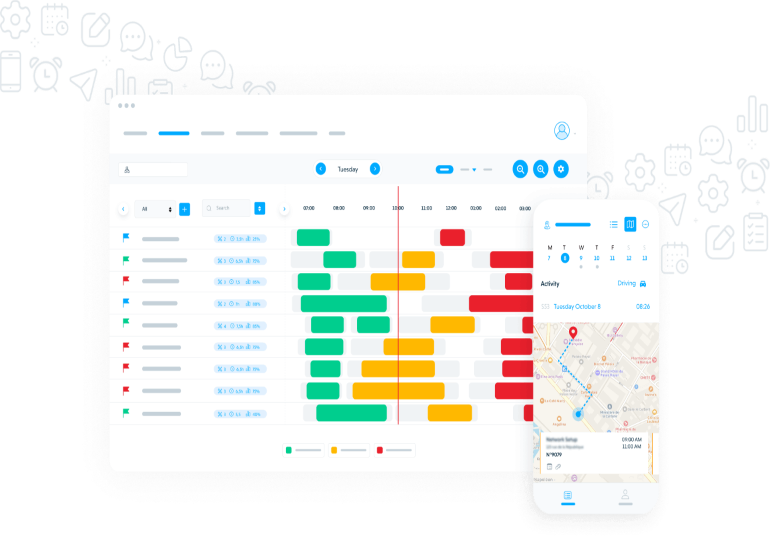
Field service management (FSM) software is a tool that allows a company to control all or part of the process of carrying out field interventions. The essential functionalities of such software typically include:
Scheduling interventions for incoming requests or recurring appointments
Reporting on completed interventions
Some FSM software also includes additional features, such as inventory management, specific alerts, or even invoicing.
The main benefit of using field service management software is time savings, which occurs at three levels:
Scheduling customer appointments or managing the frequency of interventions
Sending information to technicians
Creating a history of completed tasks
This type of software is primarily designed for sales assistants, planners, or even executive assistants in smaller organizations.
A second advantage, offered by some advanced software, is the increase in field team performance. Software that includes route optimization features can significantly increase the number of interventions completed each day.
In many companies, a dedicated planner manages scheduling. This person knows both the operational requirements of the interventions and the driving times across the service area. They typically try to group appointments geographically to minimize travel time.
However, when the number of interventions is high, manual scheduling becomes tedious, and it is nearly impossible without sufficiently powerful software algorithms—such as simple scheduling tools with only a map view. Poor planning can directly impact company operations.
Two main risks of poor planning are:
Technicians may have to travel unnecessarily across the entire territory, reducing the number of appointments per day and decreasing profitability. Costs rise while revenue drops.
Customers may be dissatisfied if given unrealistic time slots, and technicians may need to work overtime.
Intelligent planning algorithms help save time, prevent errors, and ensure routes are optimized daily, maximizing the number of interventions and guaranteeing service commitments to customers.
Here are four key criteria when selecting field service management software:
Features and usability
Software intelligence and automation capabilities
Technical aspects
Cost
Focus on essential features like scheduling and reporting. Well-designed software should also integrate with specialized tools—for example, invoicing is best handled by dedicated accounting software, and inventory management by stock management software. Evaluate how user-friendly the planning and reporting features are for management, planners, and technicians.
The main goal of FSM software is to save time. Therefore, the quality of scheduling algorithms and the degree of automation in processes and data handling are crucial. These factors should be carefully assessed in any software comparison.
Most companies now favor SaaS (Software as a Service) over On-Premise software installed on internal servers. SaaS FSM software is easily accessible on the go with just an internet connection and doesn’t require in-house IT infrastructure. Its subscription-based pricing is also attractive for many organizations.
For SaaS software, consider:
Service availability
Software response time guarantees
Support team accessibility
Integration possibilities with other systems
The cost should be evaluated in terms of ROI. While ROI is not straightforward to calculate—since it involves time savings and fulfilling customer commitments—it is critical. A high-performance FSM system can save up to 50% of the planner’s time, in addition to efficiency gains from optimized routes.





















































































































 January 26, 2026 - BY Admin