info@managtech.ma 0537 71 72 91
January 25, 2026 - BY Admin

What are the types of storage?

Modern storage methods rely on the use of storage units (e.g., pallets or wire mesh containers) and various types of racking systems. Some storage systems can be integrated with automated conveyor systems to transport particularly large or heavy storage units. Coupled conveyor systems enable a high degree of automation in goods receiving and dispatch areas.


1. Block Stacking on the Floor

Block stacking refers to storing boxes, crates, or pallets directly on top of or next to one another—without racks or other support structures. This is therefore a form of floor storage, where storage units are placed directly on the floor. The system consists of multiple parallel, uniformly sized loading and picking aisles. Within these aisles, operators move using handling equipment (e.g., forklifts or manual pallet trucks) to store and retrieve goods. On either side of these aisles are several storage columns—i.e., one or more storage positions placed behind each other, clearly marked on the floor. These storage positions have uniform width, depth, and height, defined according to the stackability of the load units.

At the front of these storage positions runs a cross aisle perpendicular to the loading and picking aisles. The rear ends of the loading/picking aisles are closed, meaning access is only possible from the front. This cross aisle connects all picking aisles to a central base station located at the midpoint of the front face, which includes a buffer zone for staging goods destined for downstream operations. A dedicated lane allows movement between the upstream supply point and the storage/retrieval system entrance. Similarly, the system features an exit for dispatching prepared goods.

Palletized stackable goods, beverages, barrels, or tires are well-suited for this storage method. Block stacking is relatively low-cost since it incurs no additional expenses for pallet racking. Thus, block stacking falls under the category of static storage systems.


2. Dynamic Racking Systems

Dynamic racking systems can be used for pallets or loose goods: either Dynamic Pallet Racking (DPR) or Dynamic Carton Racking (DCR). The layout consists of a single rectangular storage and retrieval zone, divided into parallel loading aisles, storage zones, conveyor zones, and picking aisles—all with uniform widths and lengths. Conveyor zones run along both sides of the picking aisles and may accommodate continuous transport systems such as belt conveyors. Within the storage zones, dynamic racking systems are installed. These racks consist of multiple rack columns, each made up of stacked lanes of identical width, height, and depth. Goods are transported through these lanes via rollers, moving automatically due to a slight incline (typically 3° to 8°) and gravity. Each lane contains multiple storage positions arranged in sequence. Dynamic racking enables highly compact storage within a small footprint.


A key advantage is the clear separation of logistics processes: storage and dispatch occur at different locations. Dynamic racks are loaded from one side and picked from the opposite side. Due to the roller incline, stored goods (pallets or cartons) automatically move from the loading side to the picking side. This ensures strict adherence to the “First In, First Out” (FIFO) principle and optimal batch traceability.

3. Single-Deep Pallet Racking

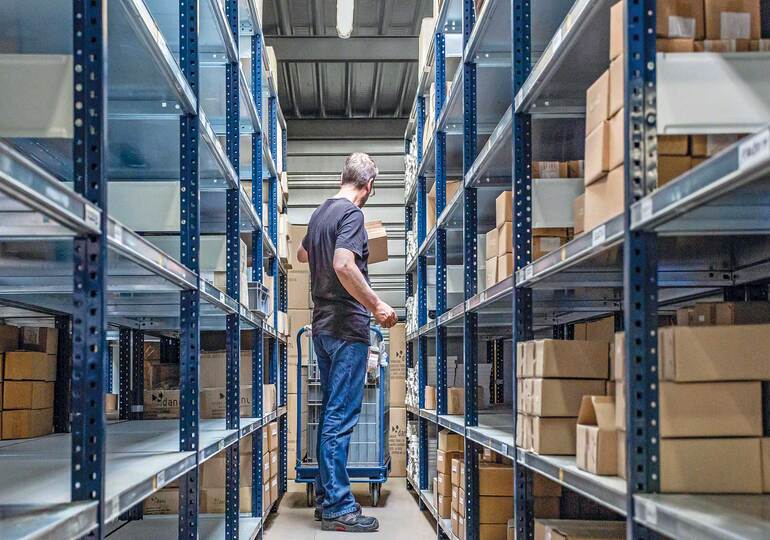
The basic unit of single-deep racking is a single shelf level. Multiple shelves stacked vertically form a rack column, and several columns placed side by side create a full rack bay. The system typically includes identical parallel racks positioned along both sides of uniform-width loading and picking aisles.

Conventional pallet racking is most commonly used for single-deep storage. This design ensures every pallet is directly accessible. If operational needs change, these racks can easily be converted into order-picking stations or reconfigured in just a few steps. Single-deep racking is therefore a flexible solution with relatively low investment costs. For loose or cartonized goods, a bolt-free, tool-free carton shelving system is used.

4. Double-Deep Pallet Racking

In warehouse layout planning, double-deep racking follows the same principles as single-deep systems—except that each shelf level holds two storage positions arranged one behind the other. This allows, for example, two identical pallets to be stored back-to-back. Thus, four pallets can be stored between two aisles, optimizing space utilization by eliminating one aisle per bay.

5. Carousel Storage Systems

A carousel storage system consists of an automated carousel and a semi-automated picking station. The carousel rack is built from uniformly sized storage positions or shelves. Stacked vertically, they form a cohesive unit called a rack column. These columns are suspended from wheels on an overhead rail system, often supported by additional ground-guided wheels for stability. A carousel comprises multiple rack columns mounted side by side, rotating together as a single circular conveyor under centralized control. In the storage and order-picking area, multiple identical carousels are placed side by side without intermediate aisles.

At the front of the carousel is a lift mechanism capable of handling two load units simultaneously, serving as the interface between the carousel and a continuous conveyor. This conveyor links the upstream supply zone to the carousel system and connects the carousel to downstream picking stations. Buffer zones are integrated at the front of the shelves to facilitate smooth handover to the lift system.

Which Storage Technology Is Right for You?

Who better to answer this question than BITO-Lagertechnik Bittmann GmbH, the German manufacturer of storage solutions? Our consulting team—reachable by phone, email, or on-site at your facility—guarantees you’ll find THE best storage solution tailored to your needs.

You can also preview our pre-selected range of storage systems right away.