What are the challenges of project management?
Challenges of project management
Project outcome
The value creation model involves identifying and selecting an opportunity before the project even begins. The project then creates a product that meets specific objectives. Once the project is complete, this product generates an outcome through its effects. This outcome then allows for the reaping of long-term benefits.
Project outputs can be:
structures (for example: a section of highway, a bridge);
tangible products with a unique character (for example: a custom-built aircraft);
intangible products (for example: software, an advertising campaign, the design of a new car model);
services (for example: a relocation, a promotional event);
change (for example: a complex internal streamlining operation, synchronizing the operations of two companies after their merger, or even two states, as after German reunification).
Objectives can be characterized by a combination of five aspects:
Functional: meeting a need
Technical: adhering to specifications and implementation constraints
Organizational: respecting the target structure's operating methods (roles, functions, culture, resistance to change)
Time-bound: meeting deadlines (planning)
Cost-bound: staying within budget
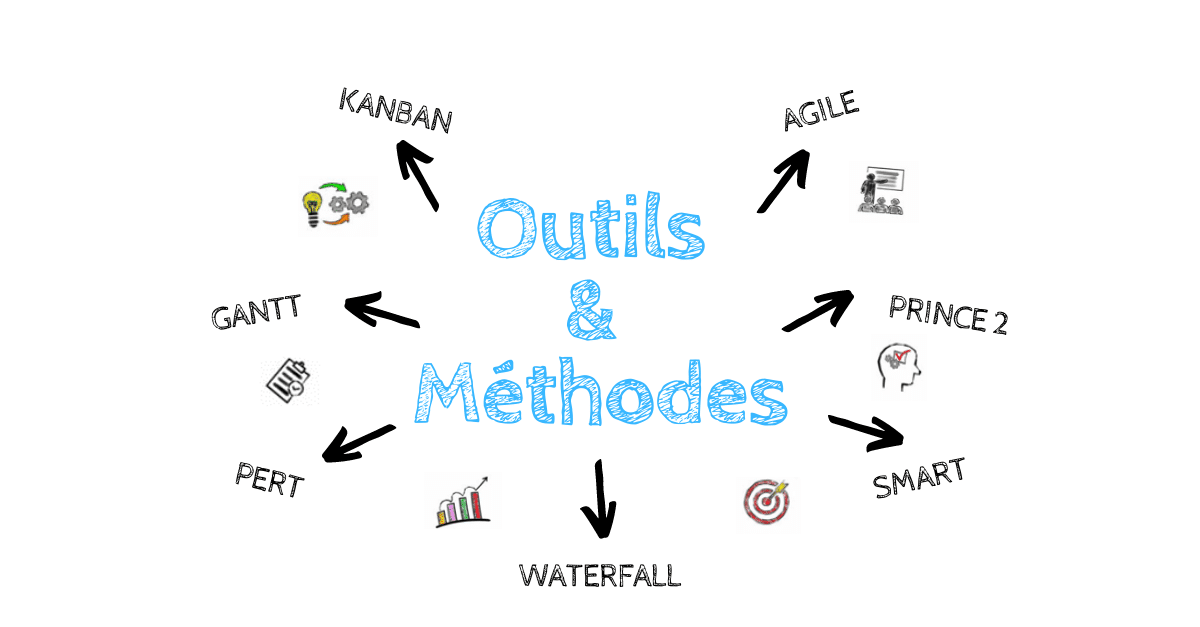
A good practice is to use SMART objectives (Specific, Measurable, Achievable, Relevant, Time-bound, Ethical).
Contract
A project may be the subject of a contract. This contract may be internal to the company in the case of innovation-related development, or commercial, based on a set of specifications. Depending on the level of shared risk, the commercial contract is chosen from several types and adapted through contractual negotiation. Examples include: the turnkey fixed-price contract, the progress-based contract, and the cost reimbursement contract, which may include an overhead bonus.
Group Dynamics
Regarding the psychosocial aspects of managing a project team, Maders distinguishes five successive phases:
The observation phase corresponds to the initial meeting of the project team members.
The cohesion phase aims to build a cohesive team.
The differentiation phase allows the team to leverage the differences between its members.
The organization phase uses traditional project management techniques to formalize resource management, planning, and risk control.
The production phase describes the actual functioning of the project team. It is at this level that the various management and leadership theories are most relevant.
Furthermore, a sixth phase, known as post-project review, is also recommended, particularly for product design projects.
Multidisciplinarity
Complex projects often require the involvement of multiple professions and disciplines. A major challenge is therefore to create a multidisciplinary team, fostering close cooperation among experts capable of meeting the needs of all the different departments within an organization: legal, marketing, IT, technical, staff training, organizational, logistical, communications, etc.
The 4 Ps of Project Management
Recent studies identify the 4 Ps that describe the entire culture of project teams:
Plan: This encompasses all planning activities related to the project;
Process: As clearly explained in the PMBOK (Project Management Body of Knowledge), projects are largely comprised of predetermined and carefully structured processes;
People: The individuals involved in a project are often at the heart of many of the problems encountered during its execution. The dreadful combination consists of a poorly designed plan coupled with incompetent individuals (both in their core skills and soft skills: their core competencies and attitudes/behaviors) regarding the tasks to be performed and the roles to be filled (the defecto effect);
Power: refers to everything related to hierarchical structures, decision-making, organizational charts, and project policies.



































































































 January 26, 2026 - BY Admin