Planning routes is a subtle art that requires considering a wide range of parameters. Modern dispatch software makes the planner’s job much easier, but the field technicians remain key stakeholders.
Intervention planning is the central process of any maintenance service. It involves assigning the right skill to the right task at the right time—a three-variable equation. The planner must account for technician locations, expertise, urgency of the intervention, expected duration, traffic conditions, weather, and spare parts inventory.
The productivity of field teams and client satisfaction depend directly on this planning optimization. The goals are twofold: maximize first-time resolution and minimize technician travel so they can spend as much time as possible with the end user.
Modern dispatch software must integrate real-time and spatial dimensions. Unlike older methods, interventions are no longer simply assigned on a first-come, first-served basis without considering technician location.
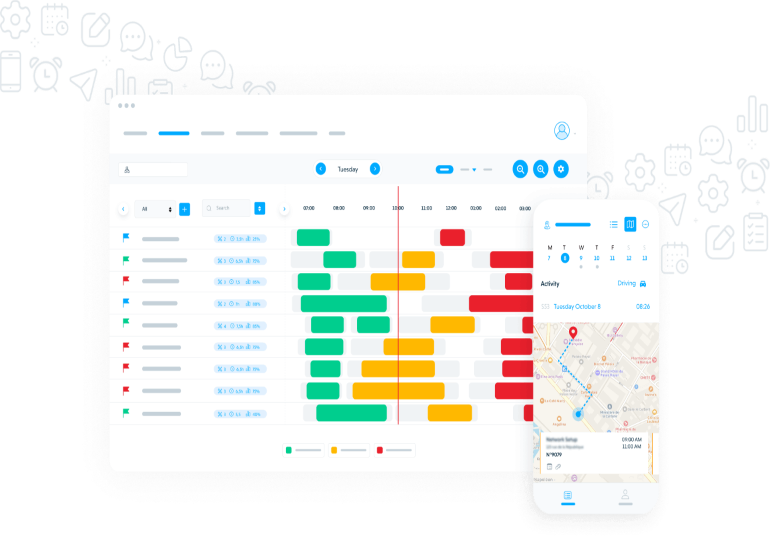
Planning requires flexibility. A dispatcher must be able to see all relevant information on a single screen to track interventions in real time and adjust schedules as needed.
The software interface must be comprehensive yet simple and intuitive. With drag-and-drop functionality, the planner can move an intervention, change its time, or assign it to another technician. Urgent cases can be handled by instantly identifying the closest available technicians.
In short, the planner can schedule or reschedule interventions on the fly with minimal actions. Clicking on a route displays technician availability and workload; clicking on an intervention allows it to be added to a route. The software then proposes an optimal time slot automatically.
Planners now have a new kind of assistant: artificial intelligence. Praxedo’s SmartScheduler is designed for companies managing a high volume of interventions with strict operational constraints. This automatic planning module uses metaheuristic algorithms that deliver results in seconds.
By processing all the criteria involved in scheduling, the AI engine pre-builds routes and quickly proposes the best possible schedule, considering travel times and workload distribution.
The AI also incorporates operational constraints, such as:
Allowing reassignment of already planned interventions
Modifying time slots
Extending technicians’ daily working hours if necessary
Planning is never static. The intelligent assistant continuously updates the model throughout the day, integrating emergencies and unforeseen events like traffic accidents. It doesn’t replace the planner but provides decision support—creating the optimal schedule collaboratively between human and machine.
Planners also schedule preventive maintenance tasks with known duration and frequency. The challenge is to balance recurring tasks with emergency interventions while managing technicians’ workload.
Modern dispatch software handles real-time constraints and gives visibility into ongoing interventions. Planners can schedule recurring maintenance while leaving open slots for emergencies. Praxedo automates these recurring interventions based on predefined frequencies for specific sites, equipment, or clients.
Despite AI and automation, route schedules are rarely perfect. Emergencies or unforeseen events can delay preventive maintenance, impacting service level agreements (SLAs).
To minimize client dissatisfaction, responsiveness is crucial. Planners must monitor field activity to know at any moment whether teams are available, en route, on-site, ahead, or behind schedule.
Technicians themselves should have the ability to “self-schedule” if needed. On their mobile device, they can see nearby interventions and claim tasks if available.
It’s also important to involve technicians in planning. Their input—such as estimating task duration—ensures schedules are realistic and improves buy-in. Real-time geolocation should be communicated as a tool to optimize travel and reduce stress, not as surveillance. Less stressed technicians deliver better service, creating a virtuous cycle.
Service managers can use historical data to refine planning. Reporting dashboards allow analysis of individual and collective performance. For example:
Some technicians take longer than average for certain tasks, so they can be deprioritized.
Others perform better in the mornings or at the start of the week, allowing schedules to reflect their strengths.
Technicians with long-standing relationships with clients can be prioritized for those accounts, improving intervention efficiency and customer satisfaction.












































































































 January 26, 2026 - BY Admin